
 By
By 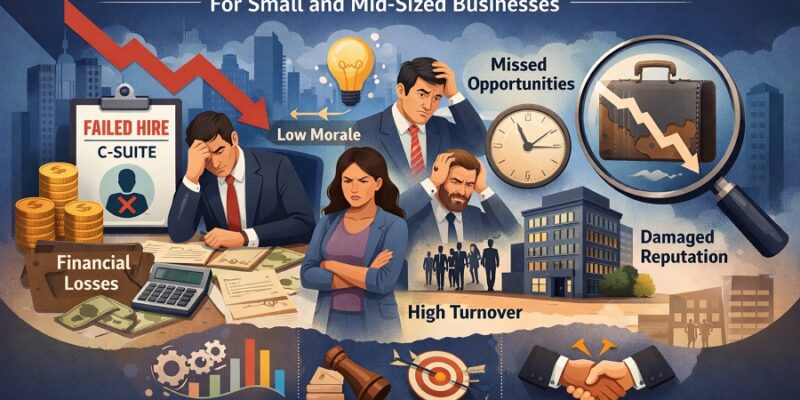
For small and mid-sized businesses (SMBs), every leadership decision carries significant weight. Unlike large corporations with layers of management and resources to absorb mistakes, SMBs operate with lean teams where each executive plays a critical role in shaping strategy, culture, and growth. This is why hiring the wrong C-suite executive is not just a setback—it can become a costly and long-lasting disruption.
A failed executive hire affects far more than just payroll. It ripples through finances, operations, employee morale, and even customer relationships. Understanding these hidden costs—and how to avoid them—is essential for sustainable growth.
The Financial Impact of a Bad Executive Hire
Direct Hiring and Replacement Costs
Hiring a C-level executive is a major investment. Between recruitment fees, onboarding expenses, relocation packages, and compensation, SMBs can spend tens or even hundreds of thousands on a single hire.
When that hire fails, these costs double. Businesses must restart the hiring process, often under pressure, leading to rushed decisions and even higher expenses. Severance packages and legal risks can further inflate the financial burden.
Productivity and Revenue Loss
A poor executive hire disrupts business momentum. Strategic initiatives may stall, teams lose direction, and decision-making slows down. This directly impacts productivity and revenue generation.
For example, a misaligned Chief Marketing Officer may launch ineffective campaigns, wasting budget and missing growth opportunities. Similarly, a weak Chief Financial Officer can lead to poor financial planning and missed investment opportunities.
At the executive level, the cost of lost productivity can far exceed the individual’s salary—sometimes reaching multiples of it.
Opportunity Cost
Perhaps the most overlooked cost is opportunity loss. While the wrong executive is in place, the business is not moving forward at its full potential.
Key opportunities—market expansion, partnerships, innovation—may be delayed or missed entirely. Leadership time is also consumed managing the fallout instead of focusing on growth.
The Operational Consequences of Failed C-Suite Hires
Strategic Misalignment
Executives define the direction of a company. A poor hire can lead to flawed strategies, inconsistent priorities, and confusion across departments.
When leadership lacks clarity or vision, teams struggle to align their efforts, resulting in inefficiencies and wasted resources.
Team Morale and Culture Damage
Employees look to leadership for guidance and inspiration. A bad executive hire can quickly erode trust, lower morale, and create internal friction.
High-performing employees are especially sensitive to poor leadership. Many may choose to leave, increasing turnover and further destabilizing the organization.
Client and Market Impact
Executives often represent the company externally. Poor leadership decisions can damage client relationships, weaken partnerships, and harm brand reputation.
In SMBs, where relationships are often personal and critical to revenue, this impact can be severe and long-lasting.
Why Executive Hiring Is Especially Risky for SMBs
SMBs face unique challenges when hiring at the executive level:
-
Limited margin for error: One wrong hire can significantly impact performance
-
Smaller teams: The executive’s influence is more direct and widespread
-
Resource constraints: Less ability to absorb financial losses
-
Lack of internal expertise: Many SMBs lack specialized hiring processes for senior roles
These factors make executive hiring a high-stakes decision where mistakes are amplified.
The Compounding Effect of a Bad Executive Hire
The true cost of a failed executive hire is not isolated—it compounds over time.
A poor strategic decision leads to missed opportunities. Missed opportunities result in slower growth. Slower growth affects revenue, which limits reinvestment in the business.
At the same time, declining morale leads to employee turnover, increasing recruitment costs and reducing team performance.
This domino effect can take years to recover from, especially for SMBs operating in competitive markets.
How Structured Executive Search Reduces Hiring Risk
The most effective way to avoid these costly mistakes is through a structured and strategic approach to executive hiring.
Role Definition and Alignment
Structured executive search begins with clearly defining the role, expectations, and success metrics. This ensures alignment between business goals and the candidate’s capabilities.
Without this clarity, even highly qualified candidates may fail due to mismatched expectations.
Access to Qualified Talent Pools
Traditional hiring methods often rely on active job seekers. However, the best executives are typically passive candidates who are not actively looking for new roles.
A structured search approach provides access to a broader and higher-quality talent pool, including global candidates with proven track records.
Rigorous Assessment and Vetting
Executive hiring requires more than reviewing resumes. Structured search includes in-depth assessments of:
-
Leadership style
-
Cultural fit
-
Strategic thinking
-
Past performance
This reduces the likelihood of costly mismatches and ensures the candidate can deliver results.
Faster and More Accurate Hiring Decisions
Time is critical in executive hiring. Prolonged vacancies can stall business operations, while rushed decisions increase risk.
A structured process balances speed and accuracy, enabling SMBs to make confident hiring decisions while minimizing disruption.
Why Partnering with Experts Matters
Working with an executive search firm specialized on recruiting c-suite executives provides SMBs with a significant advantage.
These firms bring:
-
Deep industry expertise
-
Proven hiring methodologies
-
Access to elite executive networks
-
Objective evaluation processes
More importantly, they act as strategic partners, helping businesses not only fill roles but also build leadership teams that drive long-term success.
Understanding the Different Types of C-Level Roles
Not all executive roles are the same, and hiring the wrong type of leader can be just as damaging as hiring the wrong person.
Understanding the different types of C-level executives helps SMBs align leadership roles with business needs—whether it’s growth, financial stability, operations, or innovation.
This clarity ensures that each executive contributes effectively to the company’s overall strategy.
Best Practices to Avoid Executive Hiring Mistakes
To reduce the risk of a failed executive hire, SMBs should:
-
Clearly define the role and success criteria
-
Prioritize cultural and strategic alignment
-
Use structured interview and evaluation processes
-
Conduct thorough reference and background checks
-
Partner with experienced executive search professionals
These practices create a more reliable and repeatable hiring process.
Conclusion
A bad executive hire is one of the most expensive mistakes an SMB can make. The financial losses, operational disruptions, and long-term consequences can significantly hinder growth and stability.
However, this risk is not unavoidable. By adopting a structured executive search approach and leveraging expert support, businesses can dramatically improve hiring outcomes.
In executive hiring, prevention is always more cost-effective than correction. Investing in the right process today can save substantial time, money, and effort in the future.
FAQs
What is the cost of a bad executive hire?
The cost can include recruitment expenses, lost productivity, missed opportunities, and cultural damage—often totaling several times the executive’s salary.
Why are executive hires riskier for SMBs?
SMBs have fewer resources and smaller teams, making the impact of a single leadership mistake much more significant.
How long does it take to recover from a bad hire?
Recovery can take months or even years, depending on the level of disruption and the time required to find a suitable replacement.
How can executive search firms reduce hiring risk?
They use structured processes, access high-quality talent pools, and conduct rigorous assessments to ensure better hiring decisions.






Comments